
 By Online Homework Helper
You spot a manatee gliding beside your kayak, and your instinct is to reach out. That instinct could cost you $50,000 and a criminal record.
Most people who touch wild manatees do not intend to break the law. They do not know two federal statutes apply simultaneously, or that “harassment” under those statutes is defined far more broadly than common sense suggests.
This guide covers every law, every penalty tier, and the biology behind why the rules exist in the first place.
TL;DR: Why you can’t touch a Manatee
You cannot touch a manatee because it is a federal offence under the Marine Mammal Protection Act 1972 and the Endangered Species Act 1973. Both laws prohibit any physical contact with wild manatees in US waters. Violations carry civil fines up to $25,000 and criminal penalties up to $50,000 plus one year in prison.
1. The Federal Laws That Protect Manatees
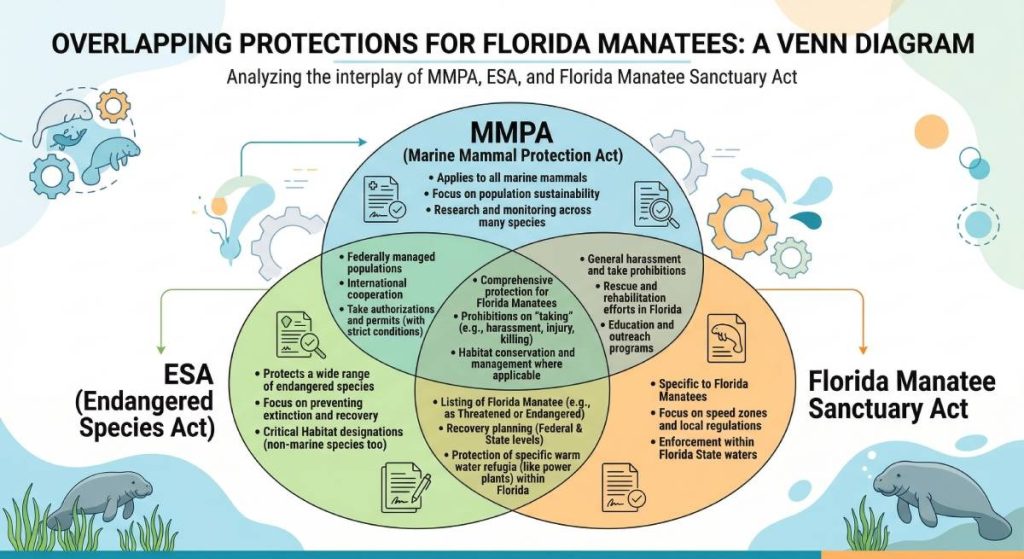
Two federal laws cover manatee protection in the United States, and both apply at the same time.
The Marine Mammal Protection Act 1972 (MMPA) prohibits the “take” of any marine mammal in US waters. “Take” is defined to include harassment, hunting, capturing, collecting, or killing. The law covers all marine mammals regardless of their endangered status.
The Endangered Species Act 1973 (ESA) adds a second layer of protection specifically for the Florida manatee (Trichechus manatus latirostris), which remains listed as a Threatened species. The ESA independently prohibits “take,” which under its definition includes harm, harassment, pursuit, hunting, shooting, wounding, killing, trapping, capturing, or collecting.
In Florida, the Florida Manatee Sanctuary Act applies on top of both federal statutes. It designates the entire state as a refuge for manatees and makes it unlawful for any person to “annoy, molest, harass, or disturb any manatee.”
2. What Legally Counts as “Harassment”
This is where most people underestimate the law. The MMPA defines two categories of harassment:
Level A Harassment: Any act that has the potential to injure a marine mammal. This includes physically touching, grabbing, lifting, or riding a manatee.
Level B Harassment: Any act that has the potential to disturb a marine mammal by disrupting behavioural patterns including migration, breathing, nursing, breeding, feeding, or sheltering. This includes chasing, cornering, separating a calf from its mother, surrounding a manatee with multiple swimmers, or persistently following one.
Feeding wild manatees also qualifies as harassment because it conditions them to associate humans with food, which draws them toward boat traffic, the leading cause of manatee injury and death.
3. Penalty Breakdown by Offence Type
| Offence | Applicable Law | Penalty Type | Maximum Fine | Maximum Prison |
| Touching / Level A Harassment | MMPA | Criminal | $20,000 | 1 year |
| Touching / Level A Harassment | ESA | Criminal | $50,000 | 1 year |
| Chasing / Level B Harassment | MMPA | Civil | $11,000 per violation | None (civil) |
| Wilful harm or disturbance | Florida Manatee Sanctuary Act | Criminal | $500 (state misdemeanour) | 60 days |
| Feeding wild manatees | FWC regulations | Civil citation | $500 per incident | None |
When federal and state charges are filed together, fines stack. A single documented incident of grabbing a manatee for a photo has resulted in federal charges under both the MMPA and the ESA simultaneously.
4. Why Physical Contact Harms Manatees
The law exists because biology demands it. There are three distinct harm pathways.
Stress physiology
Manatees are slow-moving and generally docile, which is why people assume they don’t mind contact. They do. Physical handling triggers a cortisol stress response. Chronic stress in wildlife suppresses immune function, reduces reproductive success, and shortens lifespan. A manatee that lives in a high-tourism area and is repeatedly touched experiences cumulative physiological damage.
Disease transmission
Human skin carries bacteria, sunscreens, insect repellents, and pathogens that manatees have no immunity to. Dermal contact transfers these compounds directly into the water at the point of physical interaction. Manatees breathe at the surface, which means their mucous membranes are continuously exposed.
Behavioural habituation
This is the most ecologically damaging outcome. Manatees that receive positive reinforcement from human contact (petting, feeding, play) lose their wariness around humans and boats. As of 2023, boat strikes remain the number-one documented cause of manatee injury and death in Florida, according to the Florida Fish and Wildlife Conservation Commission (FWC). A manatee conditioned to seek out humans is a manatee that loiters around marinas and boat traffic.
The behavioural habituation risk from human contact sits within a broader pattern of tourism pressure on marine mammal populations that researchers are now tracking through AI-assisted monitoring across multiple species.
5. The Crystal River Exception
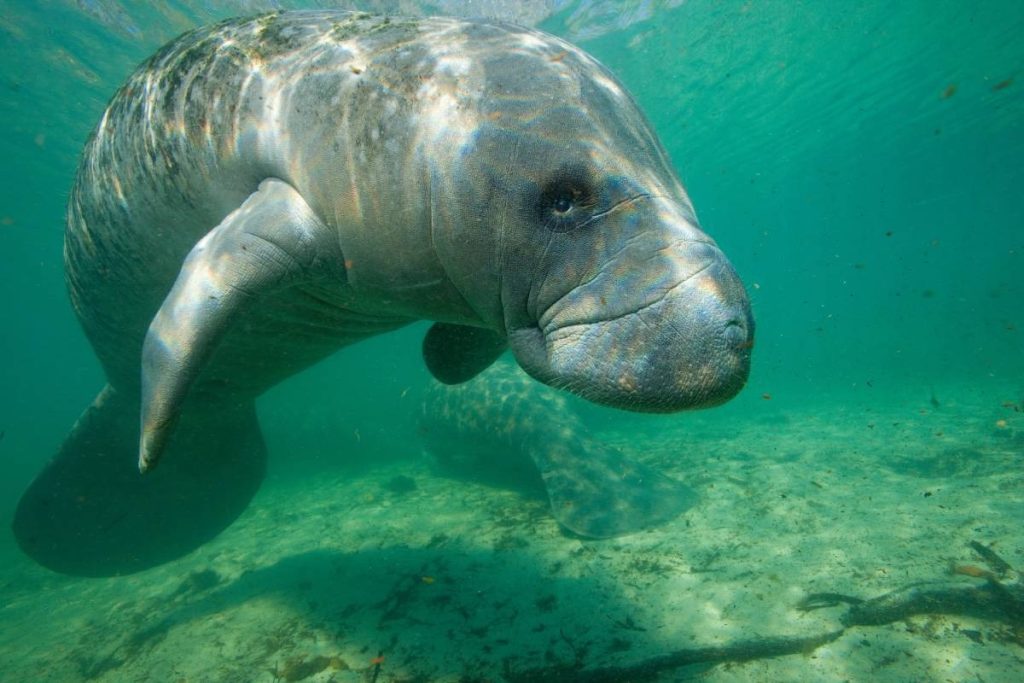
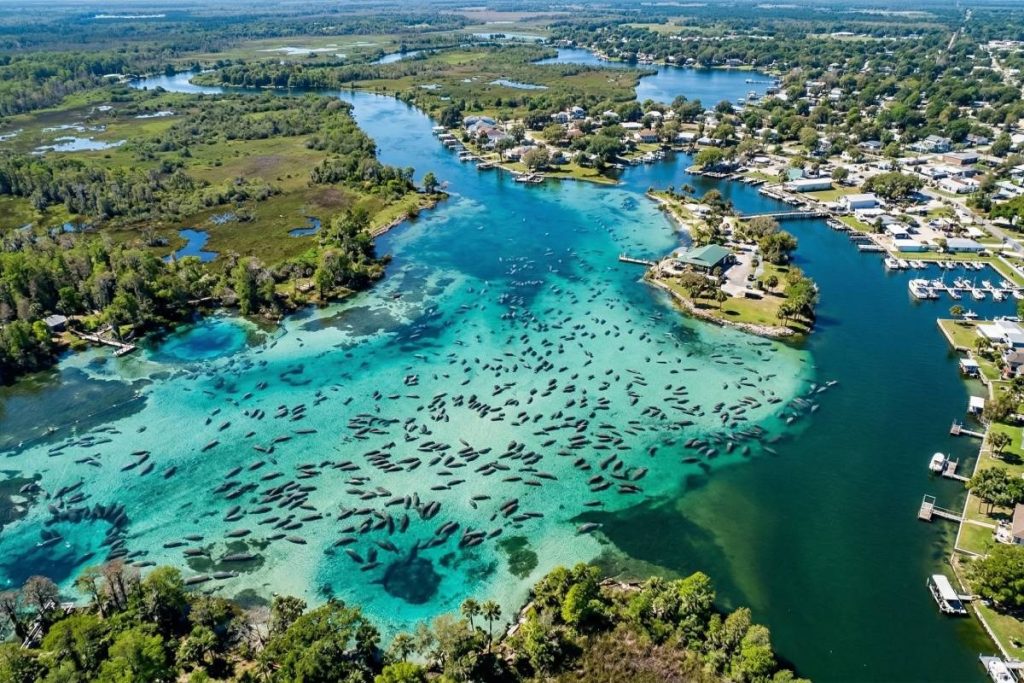
Crystal River National Wildlife Refuge in Citrus County, Florida is the only location in the United States where swimming in proximity to manatees is officially regulated and permitted. Several licensed tour operators run “swim-with-manatee” programmes there under FWC and US Fish & Wildlife Service permits.
The critical distinction is passive, unobstructed observation. The rules are strict:
- You may not pursue, chase, or follow a manatee.
- You may not surround, encircle, or block a manatee’s path.
- You may not separate a calf from its mother.
- You may not touch a manatee unless it initiates contact and swims to you.
That last point is legally nuanced. If a manatee swims up and makes contact with you, you have not committed an offence. If you reach out or move toward the animal, you have. Guides on permitted tours enforce this distinction in real time. Tourists who violate it mid-tour can and have been reported to wildlife officers.
6. Real-World Enforcement: A Documented Case
In September 2016, photographs of a Florida woman sitting astride a manatee in Fort De Soto Park went viral. The Pinellas County Sheriff’s Office identified her from the photos and charged her under the Florida Manatee Sanctuary Act. She received a criminal citation and community service.
The case is significant for two reasons. First, it confirmed that photographic evidence shared on social media constitutes sufficient grounds for prosecution. Second, it demonstrated that state-level enforcement operates independently of federal agencies. You do not need a Fish and Wildlife officer present at the scene to face charges.
Enforcement agencies now actively monitor social media platforms for wildlife harassment content. Posting a photo or video of yourself touching a manatee is not evidence you didn’t know the law. It is evidence that you did it.
7. Global Manatee Protections Beyond the US
Florida manatees receive the most documented legal protection, but other manatee species and their close relatives have protections elsewhere.
In Belize, the West Indian manatee (Trichechus manatus) is protected under the Wildlife Protection Act and the Coastal Zone Management Act. Touching or harassing a manatee carries fines and potential imprisonment.
In Brazil, the Amazonian manatee (Trichechus inunguis) is protected under IBAMA regulations as a critically endangered species. Any interaction without a scientific research permit is prohibited.
In Australia, the dugong (Dugong dugon), a close relative of the manatee in the same order Sirenia, is protected under the Environment Protection and Biodiversity Conservation Act 1999 (EPBC Act). In Queensland, dugongs receive additional protection under the Nature Conservation Act 1992. Harassment, injury, or capture carries fines up to $26,135 AUD. Australian students researching this topic should note that the same legal logic applies locally: the dugong is your regional equivalent, and the laws protecting it carry the same weight.
Summary
- Touching a manatee is simultaneously illegal under the MMPA, the ESA, and (in Florida) the state Manatee Sanctuary Act, with criminal penalties reaching $50,000 and one year in prison.
- “Harassment” is defined broadly enough to include chasing, feeding, surrounding, and separating calves from mothers, not just direct physical contact.
- Physical touch causes measurable harm through stress physiology, disease transmission, and behavioural habituation that increases a manatee’s exposure to fatal boat strikes.
Discussion question: Given that boat strikes are the leading cause of manatee death, should speed restrictions in manatee habitats be enforced more strictly than anti-harassment laws, or do both require equal regulatory pressure?
FAQs
References
- US Marine Mammal Protection Act 1972, 16 U.S.C. § 1361. NOAA Fisheries
- Endangered Species Act 1973, 16 U.S.C. § 1531. US Fish & Wildlife Service
- Florida Manatee Sanctuary Act, § 379.2431, Florida Statutes. Florida Senate
- Florida Fish and Wildlife Conservation Commission. (2023). Manatee Mortality Summary. FWC
- IUCN Red List. (2017). Trichechus manatus assessment. IUCN
- Environment Protection and Biodiversity Conservation Act 1999 (Cth), Schedule 2. Federal Register of Legislation